 |
The Association |
Hansruedi Vonlanthen
|
| |
The Association |
Hansruedi Vonlanthen
|

|
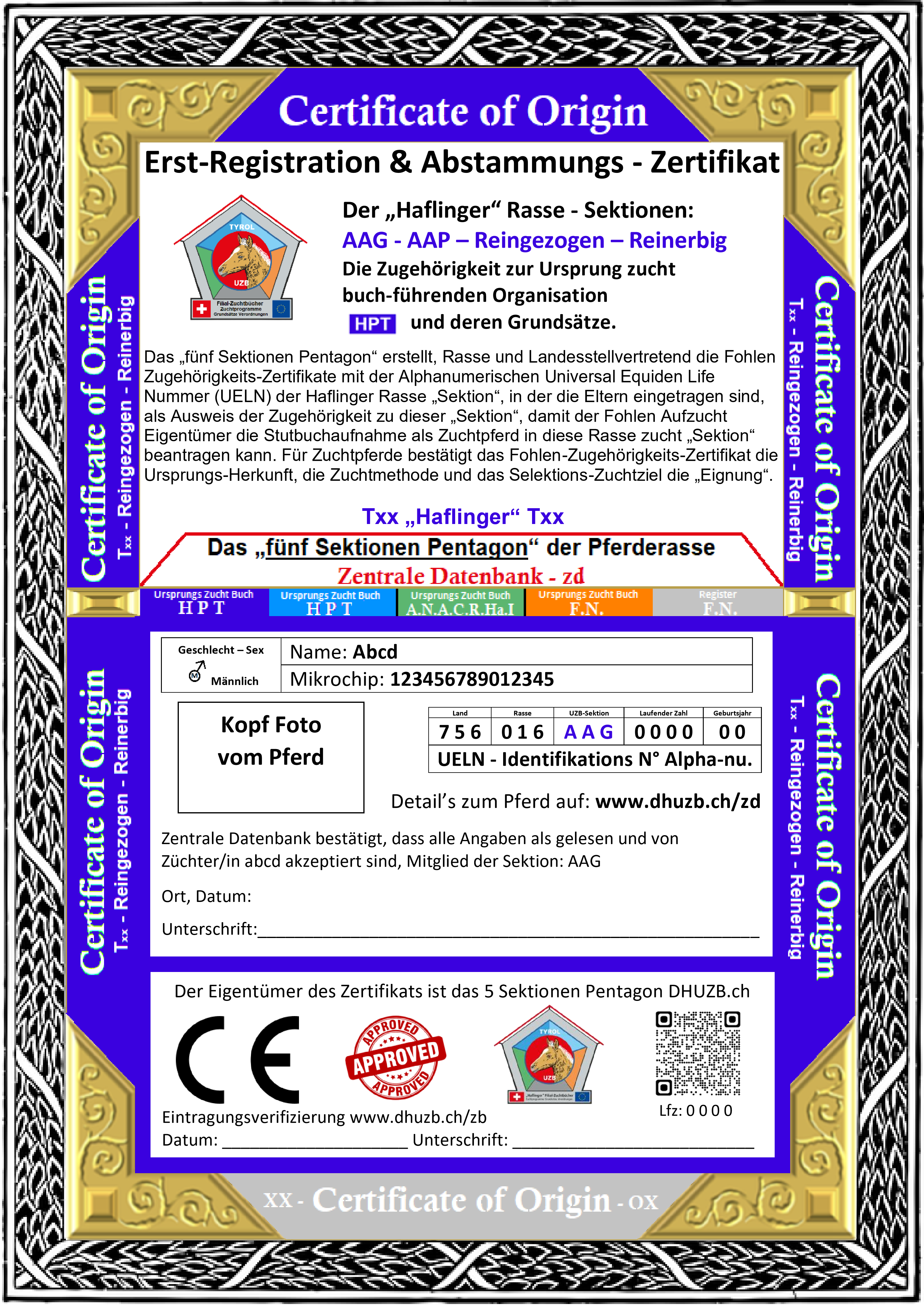
UZB – Original stud book
|
|
Section AAG -
|
|

Without subsidies from the BLW for communal foal rearing farms, it is not possible.
A communal foal rearing farm (outside of the breeding farm) brings an enormous relief for the individual breeder.
Population genetics is the discipline that deals with the structure of entire populations. Above all, population genetics is focused on capturing changes in the phenotypic and genetic structure of populations brought about by selection, specific mating procedures, the original horse type variance – steppe horse – proto-Arabian – coldblood – pony, to utilise and implement the gene pool of the breed founder "249 Folie".
In horse breeding, one deals with populations at every turn. Many works are characterised precisely by the effort to make population genetics findings usable for horse breeding.
It is inherent to population genetics that the breeding object – breeding goal is ultimately not the individual, but always the population. The general breeding value of individual animals also loses its significance without reference to a population, as it is an estimated value for the deviation of offspring from the population mean in random mating.
The individual "dominant sire" is then no longer in the foreground; rather, it is about the development and consistent implementation of an effective breeding plan (breeding method) for the entire population.
It should not be concealed here, however, that the application of population genetics and the orientation of breeding measures towards the population in horse breeding will lead to a further centralisation of breeding work. The stud breeders' association has a stud population for the breeding goal specification of its members.
Population genetics provides objective documentation for a critical selection of standard selection traits. Accordingly, this applies to breeding value estimation and breeding animal selection. This applies to the economic coefficients as well as particularly to the genetic parameters (genomic breeding value estimation).
For performance traits, a reliable assessment of the breeding value based on the observed phenotype (4 ancestors: steppe horse, proto-Arabian, coldblood + pony) is possible. Therefore, in a first stage of applying population genetics in horse breeding, broad scope must be given to developing reliable parameters. The riding horse type for the Haflinger horse is present in the gene pool. The assessment of conformation and the aptitude in the behaviour test falls within the scope of breeding management.
The challenge of estimating population parameters for the most important performance traits in riding horses lies primarily in the fact that, as a rule, the influences of the trainer and rider cannot be sufficiently separated from the performance disposition of the horse being assessed. Herein also lie considerable difficulties in conducting performance tests both at stations and especially in the field. The necessary examinations can, however, also be carried out with untrained mares. For traits where the rider significantly influences the test result, field tests have hardly any breeding significance, since there is no feasible way to satisfactorily separate the effects of the rider and the horse.
The stud breeders' association therefore forgoes the field test requirements customary in Switzerland for entry into the studbook for breeding mares and stallions.
The transfer of breeding progress occurs along the well-known four pathways:
This means that the entire mare population and not only the so-called premium breeding mares are very valuable.
The implementation of progeny testing for stallions appears particularly problematic. Doubts about the appropriateness and effectiveness of progeny testing for stallions shall be summarised in a few points:
The expansion and improvement in terms of inheritance-type-selection is therefore the most important breeding measure for the selection of stallions (English thoroughbred).
Progeny testing e.g. in sport (competition results) is replaced by type selection and behaviour testing. The stallion sires selected in this way would generally only be used for breeding stallions for 2 or 3 years, in order to keep the generation interval short. Undoubtedly, the accuracy of field testing is compromised by the level of training and the respective rider.
This depends essentially on capturing as many breeding mares as possible at a young age. First, mares with unsatisfactory fertility performance should be excluded as dam sires. In addition, attention should also be paid to a shortening of the generation interval for dam sires. Mares that were once used as dam sires based on a very good individual performance should no longer be used for breeding stallions, even if better younger mares are available. With continuous breeding progress, however, this is to be expected after a few years.
Especially during transition periods, a swift generational change should be aimed for, in order to quickly produce and offer the market-oriented Haflinger riding horse on a broad basis.
In all Haflinger breeding programmes, practically the same breeding goal is pursued today. On the other hand, the consolidation of all world breeding associations into one population HWZSV: Haflinger Welt-Zucht- und Sport-Vereinigung is not practicable due to the great distances alone. Breeding progress is furthermore promoted by competition between high-performing breeding units when pursuing the same breeding goal. In this regard too, the view must be supported that recommends a concentration of breeding work on breeding populations. It is only to be hoped that such a sensible development is not hindered by existing national borders.
High-performing breeding units are independent!
Furthermore, all test results should be repeatedly analysed in order to estimate heritability coefficients and the genetic relationships between traits.
Targeted matings between stallions and mares with the highest breeding value are then to be ensured for producing the next generation of stallion candidates with improved performance disposition.
The separation of the breeding and riding horse market is a logical measure in stud breeding. The "products" require a production facility = breeding associations, in order to serve the consumer market.
Qualifications:
 - Tyrol as a whole South and North Tyrol